The impact of Covid-19 on the Internet of Things
Curating M2M, IoT and the Universe of Smart Environments

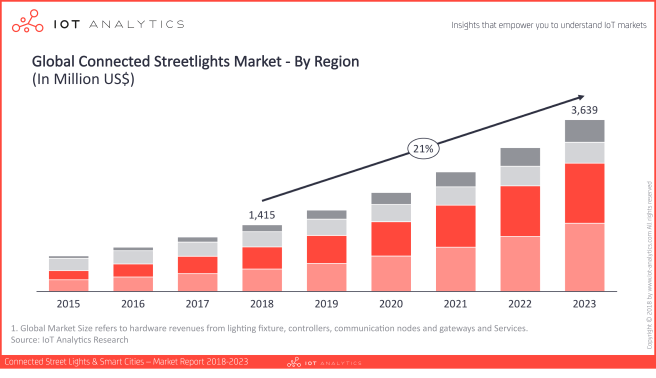
IoT Analytics, a leading provider of market insights & competitive intelligence for the Internet of Things (IoT), M2M, and Industry 4.0, today published a comprehensive Market Report, focusing on sizing the quickly developing market for Connected Streetlights during the period 2018 to 2023. It is estimated that there will be 41 million IoT connected Streetlights installed globally by 2023. The overall streetlights market will surpass US$3.6B in 2023, growing at a compound annual growth rate of 21% from 2018. Deployment of connected streetlights is gaining traction globally as the technology is one of the key pillars for Smart City initiatives. The growth is fueled by government policies and increasing awareness on the benefits of connected Streetlights which go beyond energy savings.
Machine learning has experienced a boost in popularity among industrial companies thanks to the hype surrounding the Internet of Things (IoT). Many companies are already designating IoT as a strategically significant area, while others have kicked off pilot projects to map the potential of IoT in business operations.
As a result, nearly every IT vendor is suddenly announcing IoT platforms and consulting services.
But achieving financial benefits through IoT is not easy. The lack of concrete objectives is disconcerting. The advancement of digitization and IoT places new prerequisites on both buyers and sellers. Many businesses have failed to clearly determine what areas will change with the implementation of an IoT strategy.
In other words, clearly defined, concrete intermediary objectives are missing. For example, industrial companies produce a massive amount of data on a daily basis. However, by and large, companies fail to systematically collect, store, analyze and use such data to improve process efficiency or meet other goals.
Furthermore, not many vendors are able to establish, in concrete terms, to the client how to prudently create positive impact on business operations with IoT solutions. Simply the promise of a cloud-based IoT platform is not enough.
Market analyst firm Technavio has a new report that provides a comprehensive analysis of the global IIoT sensors market in oil and gas industry by product such as temperature sensors, flow sensors, flow sensors, pressure sensors, and other sensors. The report also provides a comprehensive analysis of the growth opportunities for companies in this market in regions such as the Americas, APAC, and EMEA.
The growing focus of the oil and gas industry on reducing the cost is encouraging them to adopt IIoT sensors as the installation of these sensors takes less time. In addition, the sensor manufacturers are increasingly offering sensors with easy assembling options and technical advancements. Moreover, the rising competition among major manufacturers of sensors and service providers of IoT products is increasing, which in turn, will boost the adoption of these sensors in the oil and gas industry. Research analysis on the global IIoT sensors market in oil and gas industry identifies that the growing commercial acceptance of IIoT sensors will be one of the major factors that will have a positive impact on the growth of the market. Technavio’s market research analysts predict that the market will grow at a CAGR of more than 5% by 2022.
The preference for industrial internet of things enabled smart asset monitoring solutions add intelligence to automated workflows, real-time alerts, dynamic edge control of assets, cross-domain analytics, insights from data, real-time visibility, and predictive maintenance. This is driving the adoption of smart asset monitoring, which in turn, is identified as one of the key trends that will stimulate growth in the IIoT sensors market in oil and gas industry throughout the projected period.
GE recently launched a new book, Industrial Internet of Things for Developers, that explains much of what needs to be understood by those interested in and tasked with developing applications for the Industrial Internet of Things (IIoT). Foremost among these is that if you are going to create applications for the IIoT, the development process must change.
Forbes technology contributor Dan Woods provided a review of the book, highlighting how it helps orient developers to the unique elements of IIoT by focusing on four areas:
 The Programmable World